August weather is officially here, bringing with it the peak of our West Coast summer and occasionally...smoke. In the real estate world, the climate remains measured and tentative.
With the Bank of Canada holding interest rates steady and inflation easing, the market has settled into a comfortable, predictable rhythm, especially for buyers. We are starting to see buyers emerging again as property prices have descended into their price range, which is a good sign for the economy.
High active inventory and a slower pace of sales have kept consumer confidence cautious but opportunistic. For move-up buyers and those looking to negotiate, today's buyer's market conditions continue to present fantastic advantages.
Here is a quick, comprehensive breakdown of the July statistics across our local real estate boards to help you make sense of the present market.

GREATER VANCOUVER
Sales pull back as prices see slight year-over-year dip
The Market:
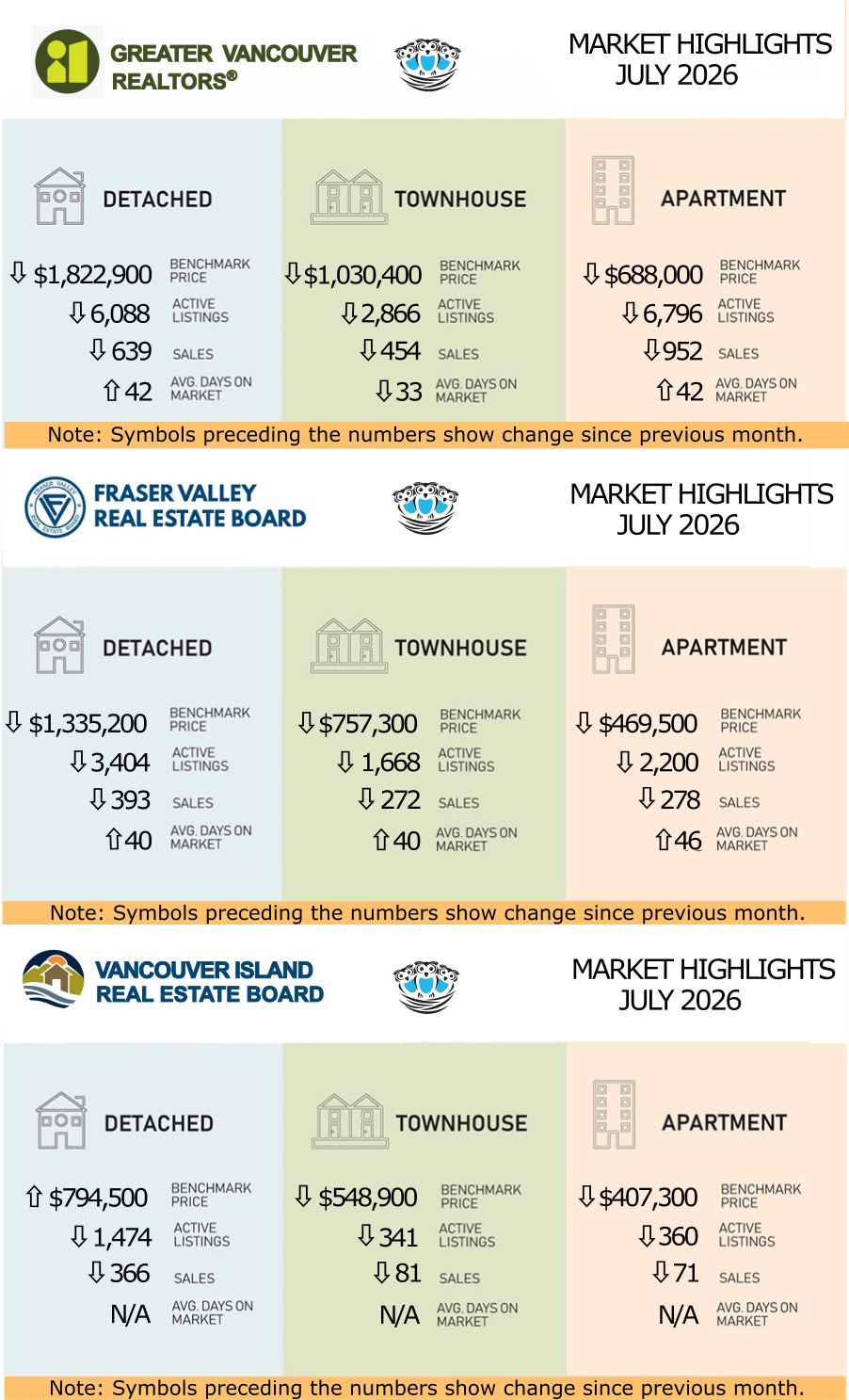
The Metro Vancouver housing market continued its transition into a calm, stable summer, characterized by a pullback in transaction volumes. The region recorded 2,045 total sales on the MLS® system in July, comprising 639 detached homes, 454 townhomes, and 952 apartments. The aggregate composite benchmark price settled at $1,088,800, marking a 9.4 per cent reduction from last year and a fractional 1.0 per cent edge down from June. Single-family detached homes sit at a benchmark of $1,822,900, while townhouses and apartments adjusted to $1,030,400 and $688,000, respectively.
The Forecast:
With demand remaining relatively muted, a healthy accumulation of active inventory is easily absorbing inbound buyer interest. Looking forward, there are no obvious near-term macroeconomic catalysts on the horizon to aggressively nudge valuations significantly in either direction, pointing to a prolonged window of price stability.
The Strategy:
• For Buyers: The current climate rewards patience and provides a fantastic window to negotiate. You are shopping in an environment with a complete absence of upward price pressure, featuring benchmark valuations that have corrected downwards across all product types over the past year.
• For Sellers: Competitive, data-backed positioning is vital. Buyers are intentionally taking their time, so an overnight success is unlikely unless a listing lines up perfectly with local market value.
Link to the full statistics report: LINK

FRASER VALLEY
Improving affordability outpaces buyer demand
The Market:
The Fraser Valley real estate market remains in buyer's territory, with inventory staying high and competition subdued. The board recorded 1,089 sales in July, which represents a 5.1 per cent month-over-month decrease and sits 8.5 per cent below the transaction volume from the same month last year. Active listings remain robust at 10,044 units, keeping total inventory well above historical norms. The composite benchmark price for a typical home dipped 0.8 per cent from June, adjusting to $877,600.
The Forecast:
Economic uncertainty continues to influence buying decisions, but the Fraser Valley has remained one of the brightest spots for improving affordability. Expect a calm, orderly, and highly measured market to continue through the rest of the summer, as households evaluate their options with significant caution.
The Strategy:
For Buyers: This remains an incredibly favorable window to pull the trigger on a purchase. Qualified buyers are finding opportunities that simply weren't available a few years ago, particularly those looking to enter the market or downsize.
For Sellers: Patience and realistic pricing are absolutely essential in today's environment. With a regional sales-to-active listings ratio of 11 per cent, the market is firmly in buyer's territory. Single-family homes and townhomes are taking an average of 40 days to sell, while apartments are averaging 46 days.

VANCOUVER ISLAND
Activity gains ground amid balanced conditions
The Market:
The housing market across Vancouver Island remains steady and well-anchored, with Realtors reporting encouraging signs of improvement in July. VIREB recorded 707 total unit sales in July, down 11 per cent from one year ago. Active regional inventory climbed two per cent year-over-year to 4,598 available homes. Board-wide single-family benchmark prices demonstrated excellent stability, settling at $794,500—reflecting a one per cent increase from July 2025 and a one per cent increase from June.
The Forecast:
While the spring and summer market was slow to get off the ground, activity is picking up, especially in the $500,000 to $750,000 price range. Expect this deliberate, unhurried pace to persist into the fall, as a stronger-than-expected national economy means significant mortgage-rate relief is unlikely in the near term.
The Strategy:
• For Buyers: You hold a solid upper hand to execute a meticulous, calculated search. Regional townhouse benchmarks sit at $548,900, while apartment options sit at $407,300, allowing you to prioritize properties where sellers have adjusted their pricing directly to meet modern market realities.
• For Sellers: Realism is the absolute key to transaction success. Sellers need to be realistic about market value in today's environment, as buyers aren't in a hurry and are willing to wait for the right property
ECONOMIC INDICATORS
The broader macroeconomic landscape continues to serve as the baseline driver for our local real estate conditions, dictating consumer confidence and purchasing power:
Interest Rates:
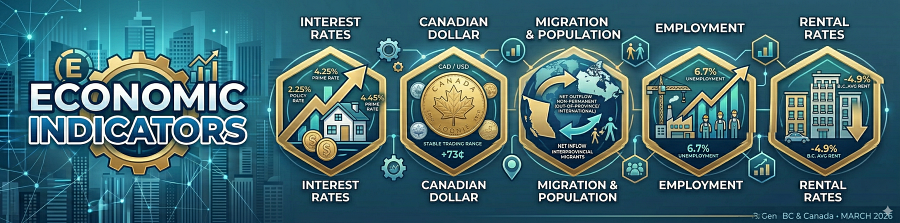
The Bank of Canada held its policy rate steady at 2.25% at its mid-July meeting, its sixth consecutive rate hold.
Forecast: With rates in a holding pattern, borrowing costs remain stable, allowing buyers to confidently map out their financing for the fall.
Inflation & Energy:
Canada's annual inflation rate eased to 2.8% in June, down from 3.2% in May, driven almost entirely by slower gasoline price growth.
Forecast: As inflation inches closer to the target rate, the likelihood of further interest rate hikes diminishes, providing a more predictable economic environment.
Employment:
The labour market demonstrated surprising strength, with the national unemployment rate falling to a two-year low of 6.4% in July, adding 75,100 jobs.
Forecast: Moderate job growth will help stabilize consumer confidence and maintain baseline housing demand through the rest of the year.
Stock Market & Currency:
The TSX Composite has exhibited ongoing resilience, trading above the 35,200 mark, while the Canadian Dollar is trading near 71 U.S. cents.
Forecast: Analysts project equities will continue to be pulled between stronger economic growth and higher bond yields, maintaining a slightly choppy near-term outlook.
Housing Starts & Immigration:
Following a period of record-breaking expansion, Canada's population contracted by 0.1% in the first quarter of 2026, representing a drop of approximately 55,000 people. This decline was driven by a 20.2% year-over-year drop in new permanent immigrants and a significant 4.4% quarterly decrease in non-permanent residents following recent federal policy shifts. Concurrently, new housing construction continues to face headwinds. The Canada Mortgage and Housing Corporation (CMHC) reported that the six-month trend in housing starts fell by 2.8% in June, with actual urban starts dropping 13% compared to June 2025.
Forecast: CMHC expects that rising development costs, weaker buyer demand, and elevated unsold inventories will continue to hold back new housing construction, driving total 2026 starts below last year's levels. Meanwhile, the easing of population growth may provide some stabilizing relief to the broader housing and rental markets as the year progresses.
Quantitative Easing & Fiscal Policy:
The federal government continues to focus on strict fiscal discipline to transition the national economy from "reliance to resilience."
Forecast: The emphasis on fiscal restraint is intended to damp domestic inflationary pressures, pointing to a gradual, stable economic recovery extending into late 2027.
What This Means For You
The intersection of real estate data and broader economics paints a very clear picture for the remainder of the summer. High inventory levels and easing inflation mean buyers face very little pressure, allowing them to take a measured approach. Sellers need to adjust to this reality. Homes priced accurately based on current local metrics are moving well, while over-ambitious listings are sitting on the market.
With rates holding steady and employment strong, well-positioned move-up buyers have a unique window to leverage existing equity before any future shifts reshape the landscape.