Now that we're officially rolling into the July summer stretch, the real estate vibe across the Lower Mainland and the Island is pretty much matching the patient pace of the broader economy.
The Bank of Canada is keeping interest rates steady at 2.25% as they balance some solid full-time job growth against those stubborn, energy-driven inflation spikes which means that local housing markets are mostly experiencing a typical seasonal shift in inventory.
Between catching the incredible buzz from the World Cup matches over at BC Place, wrapping up Canada Day long weekend festivities, and finally getting out for some great summer activities or checking off a few backyard projects, there’s a distinct window of opportunity out there.
Thanks to a healthy amount of active inventory, buyers are under zero pressure right now, making it a completely low-stress environment to step back and evaluate your options.
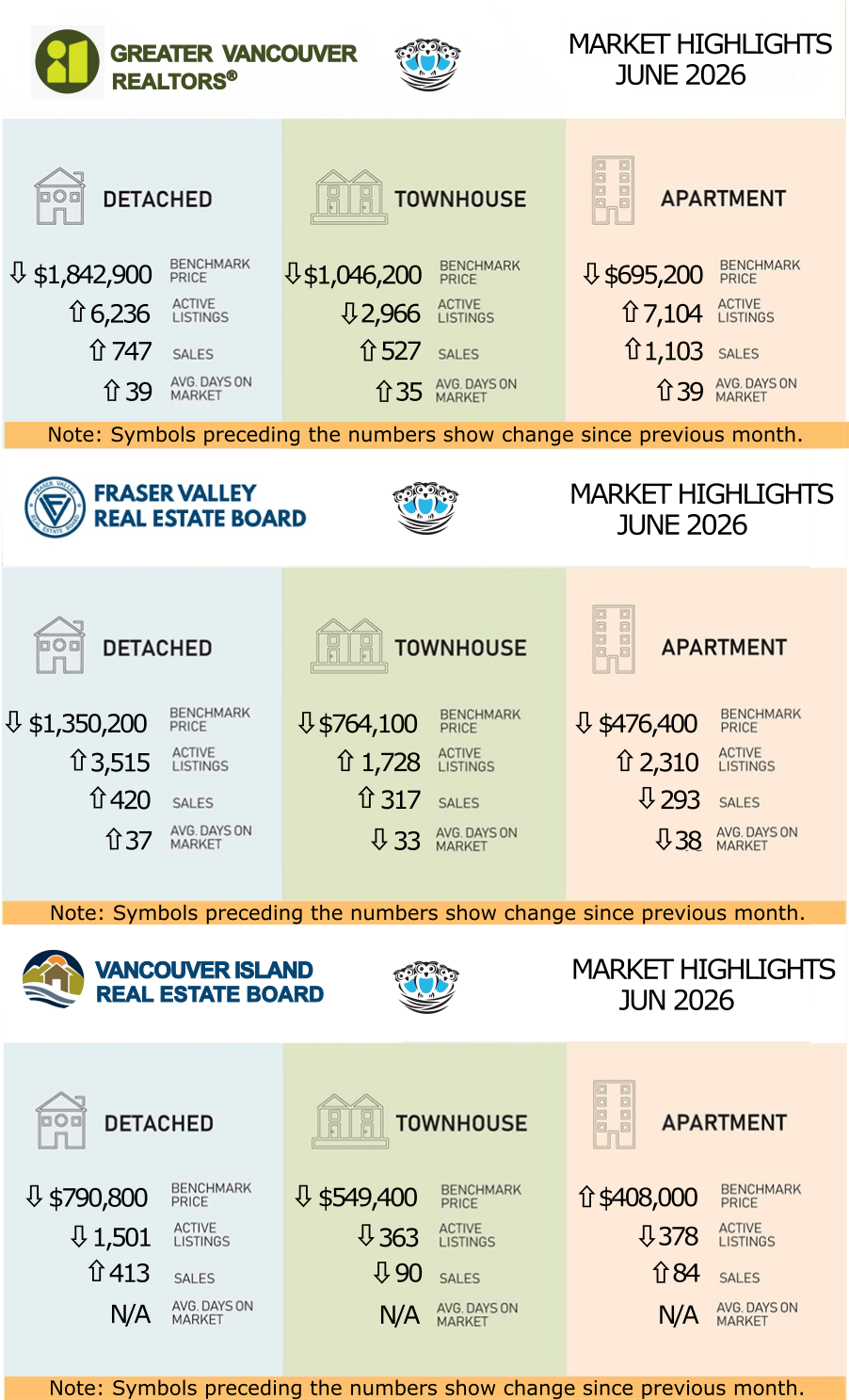
Here is your detailed breakdown of how the Greater Vancouver, Fraser Valley, and Vancouver Island markets performed last month.

GREATER VANCOUVER
Greater Vancouver home sales pick up at the start of summer
The Market:
Metro Vancouver is showing early signs of a broader market shift, highlighted by rare, synchronized sales gains across all major housing types compared to last year. This returning demand suggests a potential break from the sideways, mixed trends seen in recent years. However, this uptick hasn't translated into significant price movement because the region's substantial pool of available listings has easily absorbed the activity.
The Forecast:
Moving into summer, a slower pace of new listings means total standing inventory is no longer climbing. It is still too early to call a definitive trend, but if rising demand continues alongside a slower pace of new listings, the market may see a sustained downtrend in inventory over the coming months.
The Strategy:
• For Buyers: While prices haven't moved much recently due to healthy inventory, the supply of new listings is starting to taper off. Now is a good time to buy while choice is still elevated before shrinking inventory potentially shifts leverage back to sellers.
• For Sellers: Though demand is returning, standing inventory is still big enough to absorb it, keeping prices flat. Price your property competitively to stand out against existing inventory, but watch listing trends closely as market balance could tighten later in the season.
See the full statistics report here: LINK

FRASER VALLEY
Fraser Valley is becoming more affordable — but buyers are still holding back
The Market:
The Fraser Valley market has shifted firmly into buyer's territory, driven by steadily improving affordability and a lack of competitive urgency. Benchmark prices have softened noticeably from their historical peaks, yet the typical spring rush underperformed expectations as qualified buyers largely choose to remain on the sidelines. With a healthy level of active inventory keeping competition in check, buyers who are active in the market face highly favorable conditions and ample choice.
The Forecast:
Market activity is expected to remain relatively quiet through the summer as buyers wait to see how economic factors unfold. Over the longer term, the industry is keeping an eye on new housing supply agreements between Build Canada Homes and BC Housing, though their practical impact on consumer access remains unclear.
The Strategy:
For Buyers: Take advantage of the lack of competitive pressure and the high level of inventory. You have a unique window to take a measured approach, explore ample choices, and leverage improved affordability.
For Sellers: Realism is key. Because buyers are holding back, homes must be priced accurately based on current metrics to move, as over-ambitious listings will simply sit on the market.
See the full statistics report here: LINK

VANCOUVER ISLAND
Market remains steady as buyers weigh their options
The Market:
The Vancouver Island market remains flat but stable, heavily influenced by a cautious "wait-and-see" attitude from consumers navigating economic uncertainty. Price sensitivity is particularly pronounced at the higher end of the spectrum, where homes priced above current market expectations are taking longer to sell. In contrast, realistically priced properties are still drawing solid interest.
The Forecast:
Market activity across the board area is expected to remain relatively flat and stable in the near term. Total active inventory has stayed fairly steady year-over-year, which should maintain balanced, non-volatile conditions through the summer months.
The Strategy:
• For Buyers: The stable market gives you room to be measured and selective. For those considering downsizing, the condominium segment currently offers excellent opportunities and good availability.
• For Sellers: Realism is absolutely critical in today's market. Appropriately priced homes can still generate strong interest and even trigger multiple-offer situations, but buyers are highly price-sensitive and will pass on over-ambitious listings.
See the full statistics report here: LINK
ECONOMIC INDICATORS
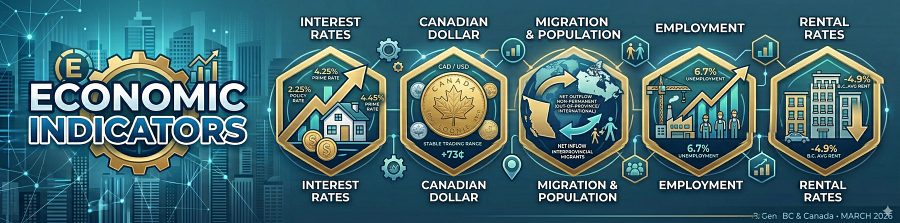
The broader macroeconomic landscape continues to serve as the baseline driver for our local real estate conditions, dictating consumer confidence and purchasing power:
Interest Rates: The Bank of Canada announced on June 10, 2026, that it is holding its target overnight rate at 2.25%. This marks the fourth consecutive hold in 2026, following pauses in January, March, and April.
Forecast: While the BoC is holding steady, Governor Tiff Macklem noted that the situation remains complex. With the next rate decision scheduled for July 15, the central bank is carefully weighing persistent inflation against recessionary pressures and potential new U.S. trade restrictions.
Inflation & Energy: Canada’s headline inflation rate jumped to 3.2% year-over-year in May 2026, up from 2.8% in April. This acceleration is largely due to the ongoing conflict in the Middle East, which pushed gasoline prices up 33.2% compared to the previous year. Grocery bills also hit households hard, with fresh vegetable prices surging 9.0% annually.
Forecast: Despite the headline spike, core inflation measures tracked by the BoC remained relatively stable around 2.0% to 2.1%. However, markets are pausing any assumptions of a summer rate cut given the continued pressures from food and energy costs.
Employment: The Canadian labor market showed surprising resilience, with the national unemployment rate tumbling to 6.6% in May 2026 from 6.9% in April. The economy added an impressive 88,000 jobs, shattering the consensus expectation of a 10,000-job gain.
Forecast: This growth was driven by a massive 154,000 jump in full-time positions. While this reflects solid hiring strength, the economy continues to operate below capacity following a disappointing first-quarter GDP contraction, which acts as a disinflationary offset to the recent energy price shocks.
Stock Market & Currency: The TSX Composite recently hit record highs fueled by a rally in gold, while the Canadian dollar weakened to a one-year low.
Forecast: Equities are expected to remain volatile as investors navigate the diverging signals of strong job growth and broader economic headwinds, while currency values will continue to fluctuate alongside global energy markets.
Housing Starts & Immigration: The total seasonally adjusted annual rate (SAAR) of housing starts in Canada fell 6% in May 2026 to 261,377 units. More concerning for the resale market, Canadian ownership housing starts (excluding purpose-built rentals) have fallen to a 26-year low of approximately 100,000 units on a 12-month rolling basis.
Forecast: With federal immigration targets remaining at over 400,000 newcomers per year, the gap between housing demand and new ownership supply continues to widen. This structural undersupply suggests that competition for available resale homes will intensify significantly heading into 2027 and 2028.
Quantitative Easing & Fiscal Policy: The federal government’s Spring Economic Update 2026 introduced the Canada Strong Fund, focusing heavily on strict fiscal discipline to transition the national economy from "reliance to resilience."
Forecast: The fund's emphasis on fiscal restraint is intended to damp domestic inflationary pressures. Consequently, real annual GDP growth forecasts for 2026 have been adjusted down to a modest 1.1% to 1.2%, pointing to a gradual economic recovery extending into late 2027.
What This Means For You
The intersection of real estate data and broader economics paints a very clear picture for this summer. High inventory levels and muted demand mean buyers face very little pressure right now, allowing them to take a measured approach. Sellers need to adjust to this reality. Homes priced accurately based on current local metrics are moving well, while over-ambitious listings are sitting on the market. However, with ownership housing starts hitting generational lows and immigration remaining high, today's buyer-friendly conditions are unlikely to last indefinitely. With rates holding steady for now, well-positioned move-up buyers have a unique window to leverage existing equity before the impending supply crunch reshapes the landscape.