
June is officially here, bringing a typical West Coast shift of sudden rain showers followed by weekend heatwaves. In the real estate world, the climate is just as distinct. High everyday costs, employment anxieties, and a holding pattern from the Bank of Canada have kept overall consumer confidence shaken. However, for financially prepared move-up buyers, today's buyers' market conditions are some of the most favorable we have seen in years. Open Houses are getting a little busier, especially for single family homes, and the number of sales is rising slightly.
Here is a quick, comprehensive breakdown of the May statistics across our local real estate boards to help you make sense of the present market.

GREATER VANCOUVER
Apartment sales lag, other housing segments steady
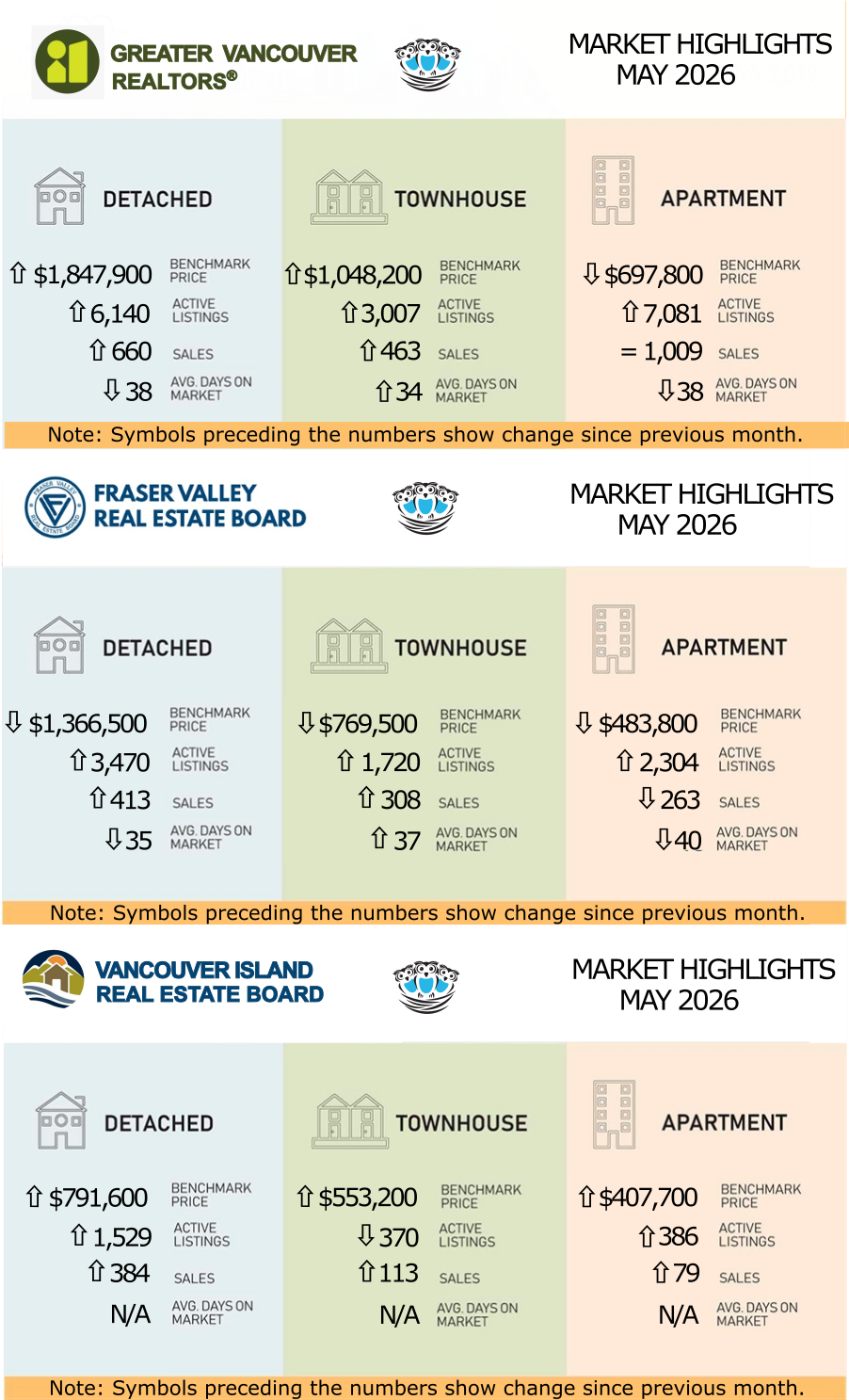
The Market: The Metro Vancouver housing market experienced a calm and stable transition into the summer gate, characterized by pulling back transaction volumes led primarily by slower activity in the multi-family sector. The region recorded 2,150 total sales on the MLS® system in May, representing a 3.5 per cent year-over-year decrease and running 26.6 per cent below the 10-year seasonal average. While the single-family detached and attached townhouse segments remained relatively steady, apartment sales lagged, dropping 7.2 per cent compared to last spring. Supply remains highly supportive for buyers; though new listings dipped 7.6 per cent annually to 6,115 units, the total active inventory pool hovered at 16,917 properties, which sits a substantial 34.6 per cent above the 10-year seasonal norm. This healthy injection of options completely leveled out home valuations, keeping month-over-month price trends entirely flat across the board. The aggregate composite benchmark price settled at $1,100,700, marking a 6.2 per cent reduction from last year and a fractional 0.2 per cent edge up from April
The Forecast: With demand tracking historical seasonal patterns and matching expectations exceptionally closely, the real estate landscape is positioned for a highly predictable, orderly summer market. Because overall demand remains relatively muted under broader economic conditions, a healthy, sustained accumulation of active inventory is easily absorbing inbound buyer interest. Looking forward, there are no obvious near-term macroeconomic catalysts or major market shifts on the horizon to aggressively nudge valuations or activity significantly in either direction, pointing to a prolonged window of price stability.
The Strategy:
For Sellers: Competitive, data-backed positioning is vital because an expansive inventory pool means your property faces extensive baseline competition. Across all housing categories, the collective sales-to-active listings ratio dropped to 13.1 per cent. The detached segment has officially dipped into buyer's market territory at 10.7 per cent, while townhouses (15.4 per cent) and apartments (14.2 per cent) remain balanced. Buyers are intentionally taking their time, so an overnight success is unlikely unless a listing lines up perfectly with local market value.
For Buyers: The current climate rewards patience and provides a fantastic window to negotiate. You are shopping in an environment with a complete absence of upward price pressure, featuring baseline benchmark valuations that have corrected between 5.1 per cent and 7.9 per cent below last year's peaks across all product types.
Click HERE for the full statistics report.

FRASER VALLEY
Falling prices open the door for Fraser Valley move-up buyers
The Market: The Fraser Valley real estate market is maintaining a cautious pace, with buyers remaining engaged but highly measured as economic uncertainty continues to shape the spring market. The board recorded 1,124 sales in May, which represents a nominal month-over-month increase of 0.5 per cent, but sits five per cent below the transaction volume from the same month last year. An abundance of choice is defining the current landscape, with active listings reaching 10,140 units—keeping total inventory well above historical norms and leaving the ball squarely in the buyer's court. Prices are showing a slight contraction after two months of gains; the composite benchmark price for a typical home dipped 0.7 per cent from April, adjusting to $893,300.
The Forecast: While the market remains active, persistent economic headwinds, elevated everyday costs, and anxieties regarding job security are acting as a drag on consumer confidence. Activity is currently being driven largely by move-up buyers utilizing existing home equity to transition into larger segments rather than a massive influx of first-time buyers. Expect a calm, orderly, and highly measured market to continue through the summer months, as households approach major financial decisions with significant caution and no immediate macroeconomic catalysts loom on the horizon.
The Strategy:
For Sellers: Patience and realistic pricing are absolutely essential in today's environment. With a regional sales-to-active listings ratio of 11 per cent, the market is firmly in buyer's territory. Single-family homes are averaging 35 days to sell, townhomes are taking 37 days, and apartments are averaging 40 days on the market—so structural alignment with localized valuations is key to finding a buyer.
For Buyers: This remains an incredibly favorable window to pull the trigger on a purchase. You currently command the field with an exceptionally healthy pool of active inventory to choose from , combined with benchmark prices that have softened between 7.6 per cent and 8.8 per cent across all property types compared to this time last year.
Click HERE for the full statistics report.

VANCOUVER ISLAND
Buyers cautious, but well-priced homes are still moving
The Market: The housing market across Vancouver Island remains steady and well-anchored, although consumer activity is dictated by a highly measured public approach. Across all product categories, VIREB recorded 768 total unit sales in May, down just one per cent from the volume seen twelve months ago. Market momentum shifted distinctly toward row-houses and townhomes, which served as a major bright spot by surging 33 per cent year-over-year to 113 transactions. Conversely, single-family detached sales ticked down four per cent annually to 384 units, though this still represents a three per cent step up from April. Active regional inventory climbed three per cent year-over-year to 4,585 available homes. Board-wide single-family benchmark prices demonstrated excellent stability, settling at $791,600—reflecting a nominal one per cent decline from May 2025 and a subtle edge up from April.
The Forecast: Ongoing broader economic uncertainty continues to affect consumer confidence across the island, prompting a noticeable segment of prospective buyers to take a cautious, wait-and-see approach before executing a purchase. Despite this hesitation, underlying activity across the VIREB zones is proving to be resiliently stable. Expect this deliberate, unhurried pace to persist into the summer, with transaction velocity depending entirely on how closely sellers match the shifting qualitative expectations of an increasingly selective buyer pool.
The Strategy:
For Sellers: Realism is the absolute key to transaction success in the current climate. On-the-ground dynamics show that properly aligned, accurately priced properties are still moving efficiently and even generating isolated multiple-offer scenarios. However, homes positioned above realistic market values are stalling heavily on the MLS® system. Local single-family trajectories vary by area; Nanaimo's benchmark dipped two per cent annually to $815,000, while the Cowichan Valley ticked up slightly to $789,800, and Parksville-Qualicum rose one per cent to $924,300.
For Buyers: You hold a solid upper hand to execute a meticulous, calculated search without the frantic timelines of previous cycles. Regional townhouse benchmarks sit two per cent lower than last spring at $553,200, and apartment options are highly stable at $407,700, allowing you to prioritize properties where sellers have adjusted their pricing directly to meet modern market realities.
Click HERE for the full statistics report.
ECONOMIC INDICATORS
The broader macroeconomic landscape continues to serve as the baseline driver for our local real estate conditions, dictating consumer confidence and purchasing power:
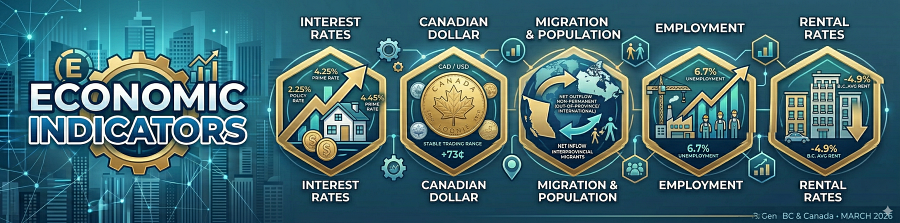
• Interest Rates: The Bank of Canada held its policy rate steady at 2.25% at its late-April meeting, balancing a sluggish 1.2% GDP growth forecast against stubborn inflation. It remains in a holding pattern ahead of the next decision on June 10, 2026.
- Forecast: While a soft start to the year supports keeping rates steady, major financial institutions are split. Some analysts expect the BoC to hold at 2.25% through the rest of the year, while others predict that persistent underlying inflation pressures could force a rate increase toward 3.0% by the end of 2026.
• Inflation & Energy: Driven by geopolitical tensions near the Strait of Hormuz pushing oil prices higher, energy costs pushed headline inflation to 2.4% in March, creeping up to 2.8% in the latest Consumer Price Index (CPI) report. Fuel prices spiked over 19% annually, though core inflation cooled slightly to 2.1%.
- Forecast: Near-term headline inflation is projected to hover close to 3% for the summer due to persistent supply chain and transportation input costs, before gradually trending back toward the 2% target as energy markets stabilize.
• Employment: The labor market is revealing some structural cracks, with the national unemployment rate remaining elevated at 6.7%.
- Forecast: Moderate job growth of roughly 25,000 seasonal positions is expected heading into the summer months, which may keep the unemployment rate moving within a narrow 6.5% to 6.8% band before stabilizing late in the year.
• Stock Market & Currency: The TSX Composite has exhibited ongoing volatility, hovering around the 33,890–33,964 mark as investors play it safe amid a flat Q1 GDP. The Canadian Dollar remains tied to energy values, trading sideways between 72 and 75 U.S. cents thanks to elevated oil prices.
- Forecast: Analysts project a choppy near-term outlook for equities. Long-term currency appreciation past 74 U.S. cents over the next 12 months depends heavily on concrete progress regarding the upcoming CUSMA trade pact review.
• Quantitative Easing & Fiscal Policy: The federal government’s Spring Economic Update 2026 introduced the Canada Strong Fund, focusing heavily on strict fiscal discipline to transition the national economy from "reliance to resilience."
- Forecast: The fund's emphasis on fiscal restraint is intended to damp domestic inflationary pressures. Consequently, real annual GDP growth forecasts for 2026 have been adjusted down to a modest 1.1% to 1.2%, pointing to a gradual economic recovery extending into late 2027.
What This Means For You
The intersection of real estate data and broader economics paints a very clear picture for this summer. High inventory levels and muted demand mean buyers face very little pressure, allowing them to take a measured approach. Sellers need to adjust to this reality. Homes priced accurately based on current local metrics are moving well, while over-ambitious listings are sitting on the market. With rates holding steady for now, well-positioned move-up buyers have a unique window to leverage existing equity before any future policy shifts reshape the landscape.