
As the spring weather has arrived with lots of sunny and warm days, we are seeing the market awaken in some very interesting ways. While overall sales volume remains relatively subdued across the province, a fascinating divergence in trends is emerging among different property types. Buyers continue to enjoy healthy inventory levels and a slower pace, but with broader economic headwinds, global tensions, and shifting inflation metrics keeping everyone on their toes, strategy and timing remain as important as ever.
Our Open Houses have been busier recently, as well. One of our listings had 15 groups through last weekend, which would have been unheard of just a few weeks ago. There is a higher incidence of multiple offers recently, just not as plentiful as years past, and sale prices are not ending up well above asking as before.
Here is your detailed breakdown of how the Greater Vancouver, Fraser Valley, and Vancouver Island markets performed last month.

GREATER VANCOUVER
Diverging trends widen as detached housing gains steam
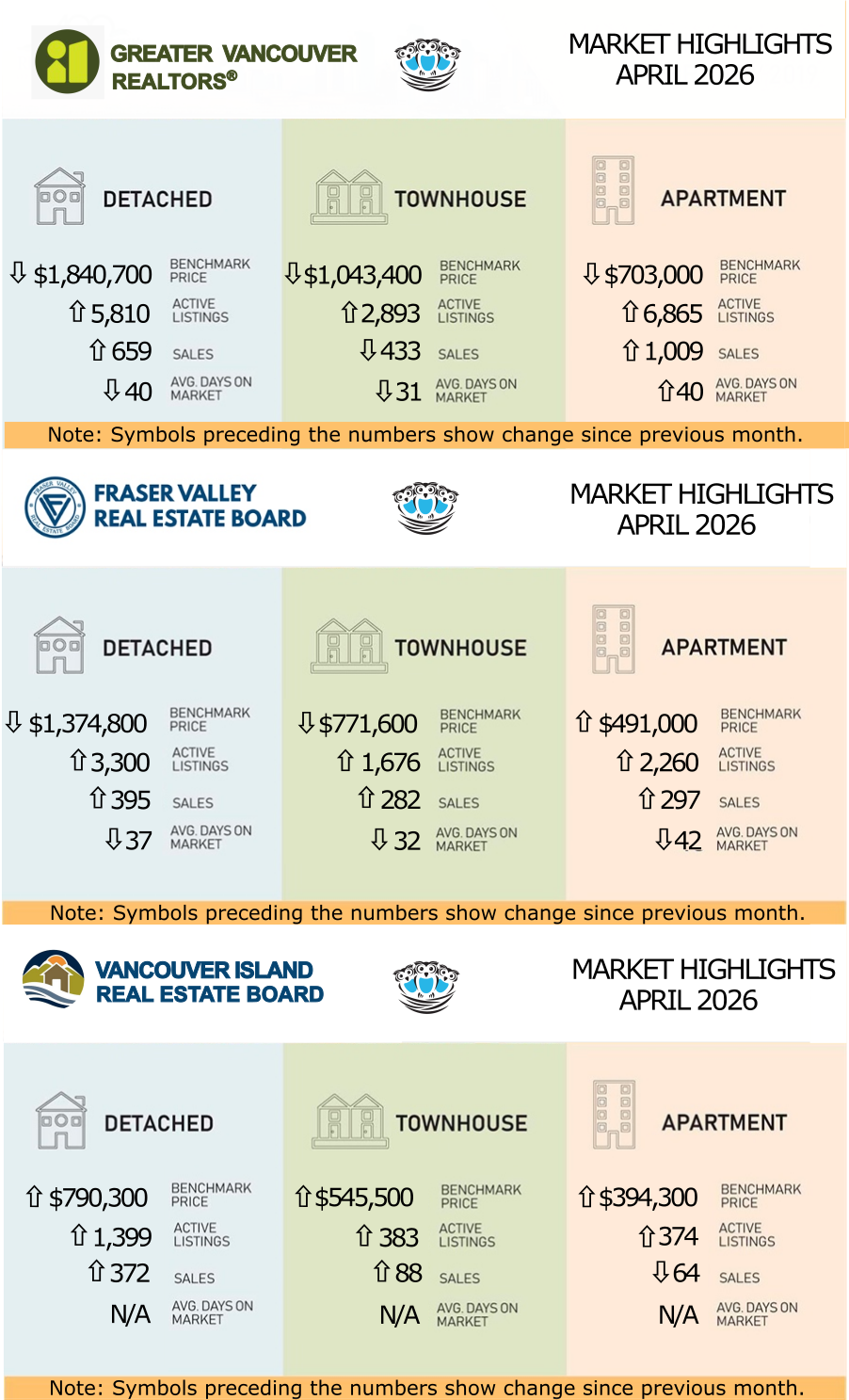
The Market: The Metro Vancouver market is currently a tale of two cities. While overall sales dipped slightly by 2.5 per cent compared to last April, there is a clear divide emerging: detached homes are gaining significant traction with a 14 per cent increase in sales, while the multi-family sector is cooling off. Sellers are certainly active, pushing total inventory to 16,236 properties—a staggering 37.9 per cent above the 10-year seasonal average. This surge in choice is keeping a lid on prices, with the composite benchmark price sitting at $1,098,000, down nearly 7 per cent from a year ago.
The Forecast: Market momentum is no longer a "blip" but a broad trend. If detached homes continue to act as a bellwether, we may see multi-family segments follow suit later this summer, provided inventory doesn't surge even further. However, with inventory levels currently so high, price escalation is likely to remain at bay for the foreseeable future.
The Strategy: For Sellers, the "detached advantage" is real, but in the condo and townhouse space, you are competing with a significant amount of standing inventory. Sharp pricing is your best tool to stand out. For Buyers, the market remains firmly in your court, especially in the detached segment where the sales-to-active ratio of 11.3 per cent is flirting with downward price pressure territory.
Click HERE for the full statistics report.

FRASER VALLEY
Rising sales and price gains hint at stability in the Fraser Valley housing market
The Market: For the first time in more than a year, the Fraser Valley recorded a year-over-year sales increase, with 1,118 units moving in April. Despite this 7 per cent annual bump, the sheer volume of listings—sitting 45 per cent above the 10-year average—means the ball remains squarely in the buyer's court. Prices are showing signs of stability, with the composite benchmark price edging up just 0.1 per cent to $899,200. It’s a "steady as she goes" environment where affordability is slowly improving, even if buyer confidence remains tempered by the headlines.
The Forecast: While activity is picking up for the spring, persistent economic headwinds and uncertainty are acting as a drag on a more robust recovery. Expect a slow build in momentum rather than a sudden surge, as buyers take a measured approach to current borrowing costs.
The Strategy: For Sellers, patience is the name of the game with an overall sales-to-active ratio of 11 per cent. Homes are taking between 32 and 42 days to sell on average, so don't expect an overnight success. For Buyers, this is a prime window to time a purchase; you have healthy inventory levels and lower prices than this time last year to work with.

VANCOUVER ISLAND
Spring market awakens with late-April uptick
The Market: The Island's spring market had a bit of a "late start" but found its legs in the back half of April. Total unit sales were down 12 per cent year-over-year, but single-family homes saw a 23 per cent jump in activity compared to March. Inventory is up 4 per cent across all types, providing a decent cushion for buyers. Prices here remain remarkably resilient; the single-family benchmark price rose slightly to $790,300, proving that the Island's appeal to retirees continues to act as a sturdy anchor for the local economy.
The Forecast: Momentum appears to be building for a busier May. Vancouver Island continues to be somewhat insulated from the wilder fluctuations seen in Vancouver, maintaining balanced conditions that favor neither side too aggressively.
The Strategy: For Sellers, the market is steady, but buyers are taking a "measured approach". Ensuring your home shows its best value is key as buyers re-engage. For Buyers, the variety in price trends across the Island is your opportunity as benchmark prices dropped 5 per cent in the North Island but rose 4 per cent in Parksville-Qualicum, so where you look matters.
ECONOMIC INDICATORS
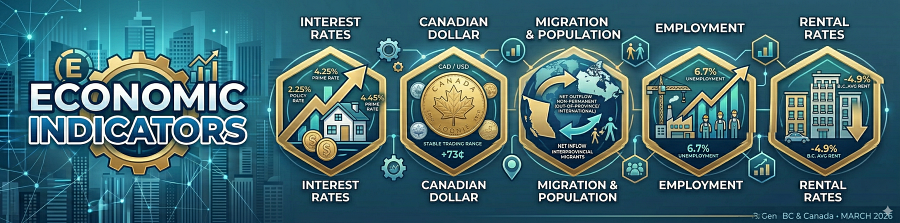
Economic indicators in April 2026 reflect a complex landscape defined by shifting migration patterns, a softening labor market, and a stabilizing interest rate environment.
The broader economic landscape continues to be the primary driver of market sentiment:
Inflation & Energy: Middle East tensions near the Strait of Hormuz have pushed oil prices up, leading to higher energy costs that drove March inflation to 2.4%. This has essentially doused any hopes for immediate rate cuts. Gas prices have reached highs of $2.419 per litre. Compare that to The Netherlands, which is the most expensive market in Europe at $3.73 per litre and the state of Georgia in the US at $1.40 per litre.
Interest Rates: The Bank of Canada kept its policy rate steady at 2.25% in late April which is now four times that they have held the rate. They are effectively in a holding pattern, balancing a sluggish 1.2% GDP growth forecast against inflation that refuses to quit.
Employment: The labor market is showing some cracks, with the national unemployment rate sitting at an elevated 6.7%. Youth unemployment is around 20%. Job losses in the first two months of 2026 were approximately 109,000 with youth employment falling by 64,000 during that period.
Stock Market & Currency: The TSX Composite has been volatile, hovering around the 33,890–33,964 mark as investors play it safe. The Canadian Dollar remains a "petro-currency" for now, stable between 73 and 75 U.S. cents thanks to those higher oil prices.
Quantitative Easing: The government’s Spring Economic Update 2026 introduced the Canada Strong Fund, focusing on fiscal discipline as they try to move the national economy from "reliance to resilience".